For decades, the BMW 3 Series has been the benchmark of sport sedans—defined by its precise handling, legendary inline engines, and perfect 50/50 weight distribution. It's been the car that made enthusiasts fall in love with driving. Now, BMW is introducing a fully electric i3 sedan that raises an uncomfortable question: Is this still a 3 Series, or something entirely new?
Understanding the New BMW i3 Sedan
Let's be clear from the start: this isn't the quirky i3 hatchback that BMW discontinued in 2022. The new i3 sedan represents something far more significant—a fully electric sedan positioned to run alongside, and potentially replace, portions of the traditional 3 Series lineup.
Built on BMW's fifth-generation eDrive technology with heavy influence from the upcoming Neue Klasse platform, the i3 sedan represents BMW's bridge between the current generation and the fully electric future. It's not just an electric variant; it's a fundamental reimagining of what a compact BMW sedan can be.
BMW's strategy here is deliberate. Rather than abandoning internal combustion overnight, they're running ICE and EV models side-by-side, allowing customers to choose their preferred powertrain while the infrastructure and technology mature. It's a pragmatic approach that acknowledges market realities while pushing toward an electric future.
Exterior Design: Evolution or Revolution?
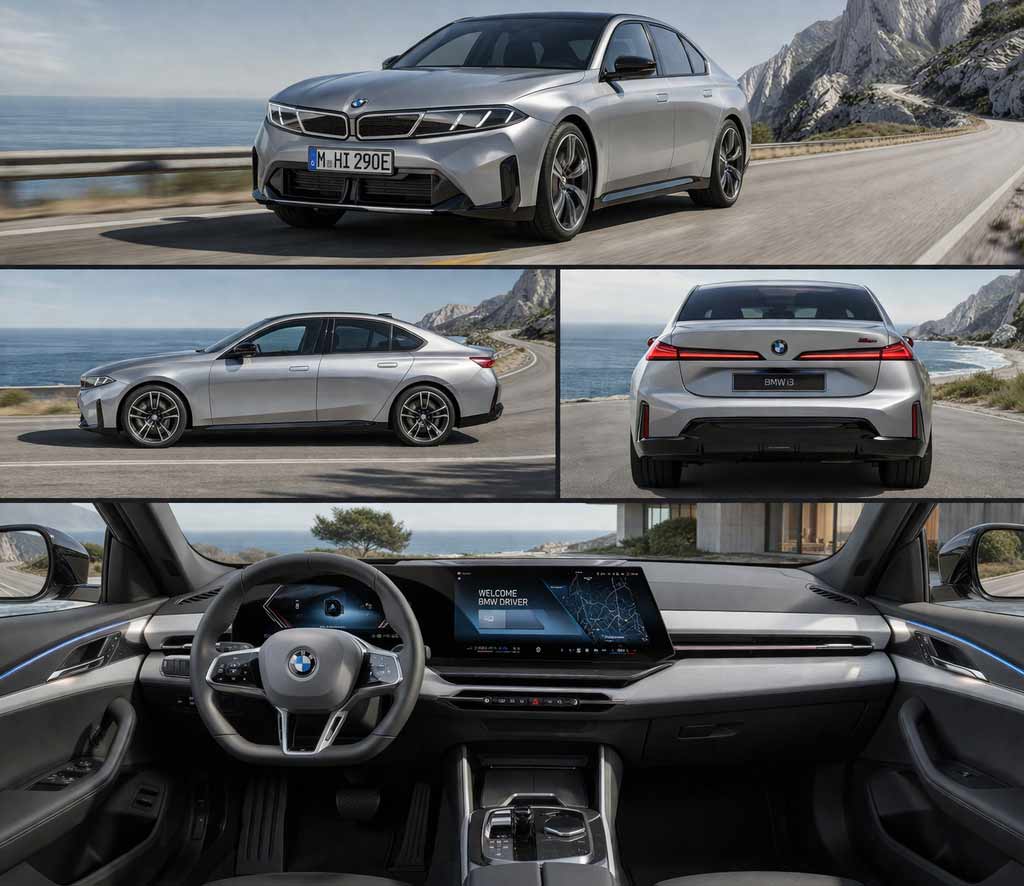
The i3 sedan's design tells the story of BMW's electric transition. The kidney grille, once a functional cooling element, has evolved into a design statement—closed off for aerodynamic efficiency but maintaining BMW's visual identity through illuminated outlines and textured surfaces.
The proportions have shifted subtly but significantly. With no engine to package, the i3 sedan features a shorter front overhang and a more cab-forward design. The wheelbase stretches longer than the current G20 3 Series, promising more interior space while maintaining the athletic stance BMW buyers expect.
Aerodynamic efficiency drives every surface. Flush door handles, active grille shutters, and carefully sculpted underbody panels help achieve a drag coefficient around 0.23—impressive for a sedan that still needs to look like a BMW. The lighting signature, with its distinctive L-shaped DRLs and laser-slim taillights, creates instant recognition while signaling the car's high-tech nature.
Interior Revolution: iDrive Takes Center Stage
Step inside the i3 sedan, and you're confronted with BMW's vision of the future cockpit. The curved display, running iDrive 9 or its successor, dominates the dashboard with a seamless integration of the instrument cluster and central infotainment screen. Physical buttons have been reduced to the essential minimum, with most functions controlled through the touchscreen, voice commands, or gesture control.
This software-first approach represents a significant departure from BMW's traditionally driver-focused interiors. The iDrive rotary controller remains, but it's been redesigned as a multifunctional hub with haptic feedback. Voice interaction, powered by BMW's Intelligent Personal Assistant, handles complex commands with natural language processing that actually works in real-world conditions.
The debate between driver-centric and tech-focused design is evident here. BMW has tried to balance both, with the curved display angled toward the driver and key driving functions still accessible through physical controls. But there's no denying this interior prioritizes digital interaction over mechanical engagement.
Performance: Redefining the Ultimate Driving Machine
The i3 sedan's performance characteristics challenge traditional BMW dynamics. With instant torque delivery from its electric motors, acceleration feels effortless and linear. The entry-level single-motor variant delivers around 280 horsepower, matching the 330i's output but with significantly more torque available from zero RPM.
The dual-motor xDrive variants push performance further, with the range-topping version expected to deliver over 400 horsepower—M340i territory. But the experience differs fundamentally from the inline-six's progressive power delivery and mechanical soundtrack.
Weight becomes the elephant in the room. Despite aluminum construction and weight-saving measures, the i3 sedan carries approximately 400-500 pounds more than its ICE counterpart due to battery mass. BMW has worked extensively on suspension tuning and weight distribution to maintain the brand's handling characteristics, placing the battery pack low in the chassis for a lower center of gravity.
Early reports suggest the i3 sedan handles with surprising agility, though the experience feels more refined and less raw than traditional 3 Series models. The instant torque vectoring from dual motors enables impressive cornering dynamics, but the overall feel prioritizes smooth efficiency over sharp engagement.
Range, Charging, and Real-World Usability
BMW targets a real-world range of 300-350 miles for the i3 sedan's long-range variants, competitive with Tesla Model 3 and other premium electric sedans. The battery pack, likely between 80-100 kWh, supports DC fast charging up to 200 kW, enabling 10-80% charging in under 30 minutes under ideal conditions.
For daily use, the i3 sedan excels. Home charging on a Level 2 charger replenishes the battery overnight, making it ideal for commuting and regular driving patterns. The integrated route planner automatically includes charging stops for longer journeys, preconditions the battery for optimal charging speeds, and provides real-time availability updates.
However, ownership realities deserve honest discussion. Public charging infrastructure remains inconsistent, with reliability and availability varying significantly by region. Long-distance travel requires more planning than with ICE vehicles, and cold weather can reduce range by 20-30%. For drivers without home charging access, the ownership experience becomes considerably more challenging.
Technology Architecture: The Software-Defined BMW
Beneath the surface, the i3 sedan showcases BMW's shift toward software-defined vehicles. The electrical architecture supports over-the-air updates for everything from infotainment features to suspension calibration and power delivery optimization.
The battery management system represents cutting-edge technology, with advanced thermal management maintaining optimal cell temperatures for performance and longevity. Predictive energy management uses navigation data, traffic information, and driver behavior patterns to optimize range and performance.
Integration extends beyond the vehicle itself. The My BMW app provides comprehensive remote functionality, from climate preconditioning to charging management and vehicle diagnostics. BMW's partnership with charging networks enables plug-and-charge functionality, automatically handling payment without apps or cards.
Market Positioning: Finding Its Place
The i3 sedan enters a increasingly competitive segment. Against the Tesla Model 3, it offers superior build quality, a more premium interior, and BMW's dealer network support. However, Tesla's Supercharger network and aggressive pricing remain significant advantages.
Within BMW's own lineup, positioning becomes complex. The i3 sedan slots below the i4 in both price and performance, targeting buyers who want BMW's electric technology in a more accessible package. Yet it potentially cannibalizes 3 Series sales, particularly among urban and suburban buyers prioritizing efficiency and technology over driving dynamics.
Pricing expectations place the i3 sedan slightly above comparable 3 Series models, reflecting the expensive battery technology. Entry-level variants likely start around $45,000, with loaded xDrive models approaching $65,000. This positions it against both premium ICE sedans and mainstream electric vehicles, requiring BMW to clearly communicate its unique value proposition.
The Bigger Question: The End of the Traditional 3 Series?
This is where the conversation gets serious. BMW has publicly committed to offering internal combustion engines through at least 2030, suggesting the traditional 3 Series isn't disappearing overnight. But the i3 sedan's introduction signals the beginning of a transition that will fundamentally reshape BMW's most important model line.
The coexistence strategy allows BMW to hedge its bets while technology and infrastructure mature. Enthusiasts concerned about losing the mechanical connection of internal combustion still have options. But each successive generation will likely shift the balance further toward electrification.
For BMW purists, this transition feels like losing something essential. The mechanical symphony of a straight-six, the perfect manual transmission, the analog connection between driver and machine—these elements defined the 3 Series experience for generations. The i3 sedan, no matter how capable, represents a different philosophy.
Yet change is inevitable. Emissions regulations, urban driving restrictions, and shifting consumer preferences make electrification necessary for BMW's survival. The question isn't whether the 3 Series will become electric, but how BMW manages the transition while maintaining its brand identity.
Final Verdict: Evolution or Compromise?
The BMW i3 sedan represents both evolution and compromise. It's an evolution in technology, efficiency, and BMW's adaptation to changing market demands. But it's also a compromise for enthusiasts who value mechanical engagement over digital sophistication.
For urban and suburban drivers prioritizing efficiency, technology, and environmental consciousness, the i3 sedan makes compelling sense. It delivers BMW quality, strong performance, and cutting-edge technology in a practical package. The instant torque and refined driving experience suit daily driving better than any previous 3 Series.
Traditional enthusiasts should stick with ICE models while they're available. The current G20 3 Series, particularly in 330i and M340i guise, represents a potential high-water mark for internal combustion sport sedans. These may be the last great driver's cars in the 3 Series lineage.
Looking forward, the i3 sedan isn't replacing the 3 Series—it's redefining it. Whether that redefinition maintains the essence of what made the 3 Series special depends largely on your perspective. For BMW, it's not about choosing between past and future, but managing the transition in a way that honors heritage while embracing necessity.
The i3 sedan isn't replacing the 3 Series overnight—but it's quietly redefining what the 3 Series will become over the next decade. Smart buyers will recognize this transition period as an opportunity to experience both the best of BMW's ICE heritage and the promise of its electric future.