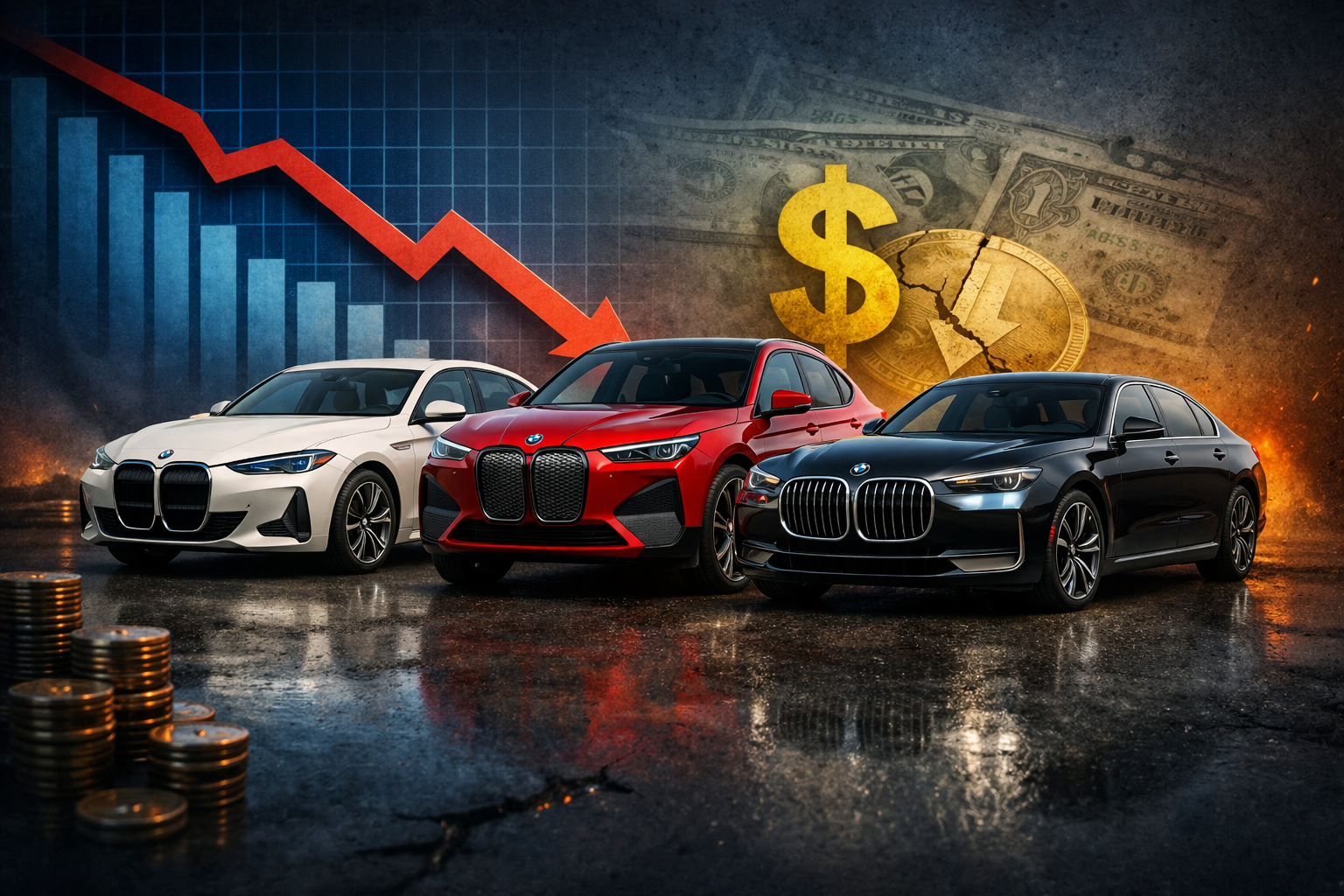
The luxury EV market is experiencing a seismic shift in valuation dynamics, and BMW's electric lineup sits at the center of this transformation. With used electric vehicle prices plummeting across brands, prospective buyers are asking critical questions: Do BMW EVs hold their value? Are the i4, iX, and i7 depreciating faster than their gasoline counterparts? Most importantly, does this depreciation create an unprecedented buying opportunity?
This comprehensive analysis examines real-world depreciation trends for BMW's three primary electric models—the i4 sports sedan, iX SUV, and flagship i7 luxury sedan. We'll decode the market forces driving these values and provide actionable insights for buyers navigating this evolving landscape.
Why EV Depreciation Follows Different Rules
Electric vehicles depreciate according to fundamentally different market dynamics than traditional combustion engines. The primary driver isn't mechanical wear—it's technological evolution. Battery technology improves approximately 5-8% annually, making today's EVs technically inferior to tomorrow's models before they even leave the showroom.
Government incentives further complicate valuation. Federal tax credits effectively reduce the transaction price by up to $7,500, yet this discount doesn't reflect in MSRP-based depreciation calculations. When a buyer purchases a $70,000 BMW i4 with a $7,500 credit, they've essentially paid $62,500—but depreciation metrics still calculate from the full MSRP.
Leasing programs have flooded the used market with off-lease EVs, creating oversupply in certain segments. BMW Financial Services has aggressively promoted EV leases with subsidized rates, resulting in lease penetration exceeding 80% for some models. These vehicles return to market in 24-36 months, pressuring residual values.
Consumer perception and charging infrastructure concerns add another layer. Range anxiety, charging speed improvements, and infrastructure expansion create a moving target for value perception. Early adopters who paid premium prices now compete with improved technology at lower price points.
BMW i4 Depreciation Analysis
The BMW i4 represents BMW's most accessible electric offering, competing directly with the Tesla Model 3 and Genesis Electrified G70. Launched in 2022, the i4 has accumulated sufficient market data to reveal clear depreciation patterns.
| Model | Original MSRP | Current Used Price (2022) | Depreciation |
|---|---|---|---|
| BMW i4 eDrive40 | $59,400 | $42,000-45,000 | 24-29% |
| BMW i4 M50 | $71,800 | $50,000-54,000 | 25-30% |
| BMW i4 eDrive35 | $51,400 | $36,000-38,000 | 26-30% |
The i4's depreciation aligns closely with traditional luxury sedan patterns, performing stronger than many analysts predicted. Several factors contribute to this relative stability: shared platform economics with the 4 Series Gran Coupe reduce development costs, strong demand from traditional BMW buyers transitioning to electric, and competitive lease residuals supporting used values.
Compared to the Tesla Model 3, which has experienced 35-40% depreciation over similar timeframes, the i4 demonstrates BMW's brand strength in maintaining residual values. The M50 variant shows particular resilience, with M badge cachet translating to electric powertrains.
BMW iX Depreciation Analysis
BMW's flagship electric SUV occupies a unique market position, competing with the Tesla Model X, Mercedes EQS SUV, and Audi e-tron. The iX's bold styling and premium pricing create distinct depreciation characteristics.
| Model | Original MSRP | Current Used Price (2022) | Depreciation |
|---|---|---|---|
| BMW iX xDrive50 | $87,100 | $58,000-63,000 | 28-33% |
| BMW iX xDrive40 | $84,100 | $56,000-60,000 | 29-33% |
| BMW iX M60 | $111,500 | $78,000-85,000 | 24-30% |
The iX demonstrates typical luxury SUV depreciation patterns, amplified by EV-specific factors. High initial MSRPs create larger absolute dollar losses, while polarizing design limits the buyer pool. Interestingly, the M60 variant shows stronger residual retention, suggesting performance-oriented EV buyers prioritize capability over efficiency.
Supply dynamics significantly impact iX values. BMW initially constrained production, but increased availability in 2023-2024 shifted market balance. Off-lease units beginning to enter the market in late 2024 will likely pressure values further.
BMW i7 Depreciation Analysis
The i7 represents BMW's electric flagship, competing in the ultra-luxury segment against the Mercedes EQS and Lucid Air. With MSRPs exceeding $120,000, the i7 faces the steepest depreciation challenges.
Early market data suggests first-year depreciation approaching 35-40%, consistent with historical 7 Series patterns regardless of powertrain. The $119,300 i7 xDrive60 trades between $75,000-85,000 after 12-18 months, while the $169,495 i7 M70 shows similar percentage losses.
Ultra-luxury buyers typically lease rather than purchase, with lease penetration exceeding 85% for the i7. This creates a predictable flood of off-lease inventory, pressuring residuals. The i7's depreciation mirrors traditional flagship sedan patterns—rapid initial drops followed by stabilization.
EV Incentives and Their Impact on Resale
Federal EV tax credits fundamentally distort depreciation calculations. When buyers receive $7,500 credits, they've effectively paid less than MSRP, yet depreciation percentages calculate from the full price. This creates an artificial inflation of depreciation rates.
Lease incentives compound this effect. BMW Financial Services often applies the federal credit as a lease cash incentive, reducing monthly payments but concentrating depreciation impact when vehicles return to market. Some i4 leases have included $10,000-12,000 in total incentives, creating a significant gap between MSRP and actual transaction values.
State incentives add regional variations. California's additional rebates, Colorado's tax credits, and New Jersey's sales tax exemptions create geographic price disparities in the used market. A used i4 might command $3,000-5,000 premiums in states without strong EV incentives.
Comparing BMW EV Depreciation vs Gas BMWs
Direct powertrain comparisons reveal nuanced depreciation patterns:
BMW i4 vs 4 Series Gran Coupe: The i4 shows 2-4% higher depreciation in years 1-2, but the gap narrows by year 3. Total ownership costs favor the i4 due to reduced maintenance and fuel savings.
BMW iX vs X5: Nearly identical depreciation curves, with the iX showing marginally higher losses offset by lower operating costs. The X5 plug-in hybrid shows the steepest depreciation, combining EV uncertainty with complex hybrid systems.
BMW i7 vs 7 Series: Minimal depreciation differences, with both losing 35-40% in the first year. The i7's simpler mechanicals may provide long-term value advantages.
The Used BMW EV Opportunity
Current depreciation patterns create extraordinary value propositions for second owners. A two-year-old i4 M50 offers 95% of the performance and features of a new model at 70% of the cost. With BMW's 8-year/100,000-mile battery warranty transferring to subsequent owners, reliability concerns diminish.
Maintenance savings amplify the value equation. BMW EVs require minimal scheduled maintenance—no oil changes, fewer brake replacements due to regenerative braking, and simplified cooling systems. A used i4 owner might save $3,000-5,000 in maintenance over five years compared to a comparable 4 Series.
Performance degradation remains minimal. BMW's conservative battery management typically shows less than 5% capacity loss after three years, maintaining practical range and acceleration. Unlike combustion engines that lose performance with wear, electric motors deliver consistent output throughout their lifespan.
Market Prediction: The Next 5 Years
BMW's Neue Klasse platform, arriving in 2025, will significantly impact current model values. The sixth-generation eDrive technology promises 30% greater range and 30% faster charging, potentially accelerating depreciation of current models. However, this same dynamic creates buying opportunities as capable current-generation vehicles become 'previous tech.'
EV adoption rates suggest a maturing market by 2028-2029, with depreciation curves normalizing toward traditional luxury car patterns. The i4 will likely stabilize at 50-55% residual value after three years, matching 4 Series patterns. The iX faces greater uncertainty due to rapid SUV EV competition, while the i7 will follow traditional flagship depreciation regardless of powertrain advances.
Battery replacement costs, currently $15,000-25,000, will likely decrease to $8,000-12,000 by 2029, improving long-term ownership economics. Charging infrastructure expansion will reduce range anxiety premiums, normalizing EV values relative to combustion alternatives.
Final Verdict
Are BMW EVs depreciating faster than expected? The answer depends on perspective. Compared to mainstream EVs like Tesla, BMW's electric lineup shows stronger residual retention. Against BMW's own combustion models, EVs show marginally higher depreciation concentrated in early ownership years.
The current depreciation represents a market maturation rather than a fundamental flaw. Early adopters paid innovation premiums that subsequent buyers won't bear. For buyers entering the market now, BMW EVs offer exceptional value propositions—cutting-edge technology, lower operating costs, and premium features at significant discounts to original MSRPs.
The smart money recognizes this as an opportunity rather than a concern. A carefully selected used BMW EV delivers the brand's legendary driving dynamics with forward-looking technology at historically attractive prices. As the market stabilizes and EV adoption accelerates, today's depreciation anxiety will likely seem as quaint as concerns about early smartphone battery life. For buyers willing to embrace the electric transition, there's never been a better time to join BMW's electric future.