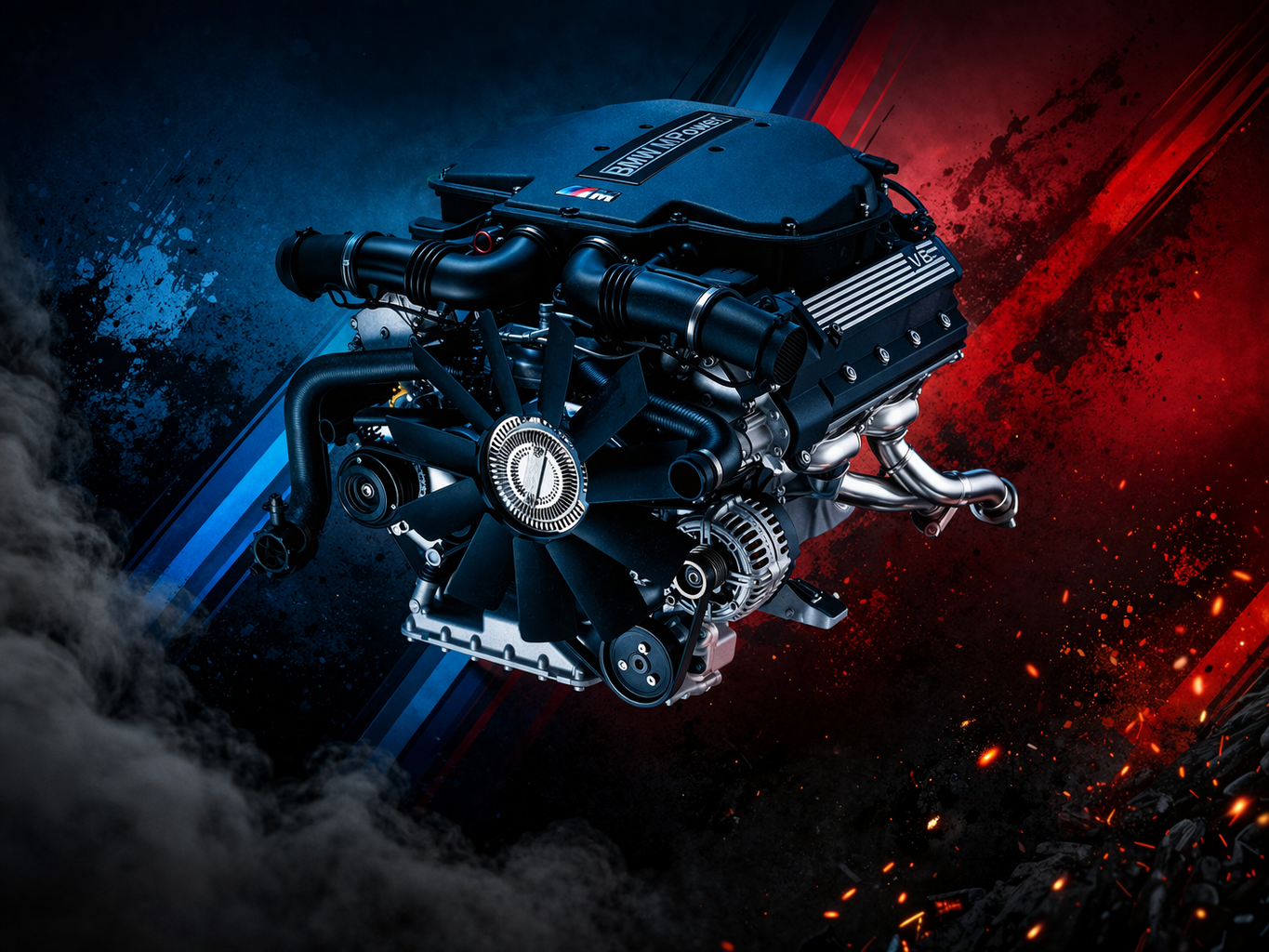
You've just finished a spirited drive in your BMW, and as you step out of the car, that unmistakable burning oil smell hits your nose. Or perhaps you've noticed a small oil spot on your garage floor that wasn't there yesterday. If you own a BMW with a V8 engine — whether it's an N62, N63, or S63 — you're likely familiar with this scenario.
The good news? Most BMW V8 oil leaks are predictable and preventable. These engines aren't fundamentally flawed; they simply require proactive maintenance to keep them leak-free. Understanding why these leaks develop and addressing them early can save you thousands in repair costs and keep your BMW running perfectly for years to come.
Why BMW V8 Engines Develop Oil Leaks
BMW V8 engines are engineering marvels, but their complexity and operating conditions create unique challenges for long-term seal integrity. Here's why these engines are prone to developing oil leaks:
Extreme Engine Heat: BMW V8s run hot — very hot. The combination of high compression ratios, performance-oriented tuning, and dense engine packaging means operating temperatures regularly exceed 200°F. This constant heat cycling gradually hardens rubber gaskets and seals, making them brittle and prone to failure.
Tight Engine Packaging: Modern BMWs pack their V8 engines into increasingly compact spaces. This design philosophy improves weight distribution and handling but leaves little room for heat dissipation. Components are crammed together, creating heat pockets that accelerate seal degradation.
Turbocharger Heat (N63/S63): The twin-turbo N63 and S63 engines face additional challenges. With turbos nestled in the engine's "hot V" configuration between the cylinder banks, temperatures soar even higher. This innovative design improves throttle response but subjects nearby seals to extreme thermal stress.
Positive Crankcase Ventilation (PCV) Issues: As BMW V8s age, their PCV systems can become less efficient. This leads to increased crankcase pressure, which literally pushes oil past aging seals. It's a cascading effect — minor seal degradation becomes major leaks as pressure builds.
Material Degradation: Even the highest quality rubber compounds have a finite lifespan. After 60,000-80,000 miles of heat cycles, chemical exposure, and mechanical stress, gaskets lose their elasticity. What starts as minor seepage becomes active leaking.
Most Common BMW V8 Oil Leak Points
Not all oil leaks are created equal. Some are simple weekend DIY projects, while others require significant labor. Here are the most common culprits:
1. Valve Cover Gaskets
The number one oil leak source on BMW V8s. These gaskets seal the top of each cylinder bank and face constant heat exposure.
Symptoms include:
- Burning oil smell after driving (oil drips onto hot exhaust manifolds)
- Oil residue on the sides of the engine
- Smoke from the engine bay after hard driving
- Oil accumulation near spark plug wells
2. Oil Filter Housing Gasket
Located at the front of the engine, this gasket endures both heat and constant oil pressure. When it fails, oil leaks down the front of the engine.
Symptoms include:
- Oil on the front engine belly pan
- Oil contamination of the serpentine belt
- Drips near the oil filter area
- Belt squealing from oil contamination
3. Upper Timing Cover Seals
These seals prevent oil from escaping where the timing chain covers meet the engine block. Age and heat cause them to shrink and leak.
4. Turbo Oil Lines (N63/S63 Only)
The oil feed and return lines for the turbochargers operate under extreme conditions. The combination of high pressure, temperature, and vibration often causes leaks at connection points.
5. Oil Pan Gasket
While less common than valve cover leaks, oil pan gasket failures are more expensive to repair due to labor intensity. Subframe dropping is often required.
| Leak Source | Affected Engines | DIY Difficulty | Typical Repair Cost |
|---|---|---|---|
| Valve Cover Gaskets | All V8s | Moderate | $800-1,500 |
| Oil Filter Housing | All V8s | Easy-Moderate | $400-800 |
| Upper Timing Covers | N62, N63 | Difficult | $1,200-2,000 |
| Turbo Oil Lines | N63, S63 | Very Difficult | $1,500-2,500 |
| Oil Pan Gasket | All V8s | Very Difficult | $2,000-3,500 |
Preventative Maintenance BMW Owners Should Do
The key to avoiding expensive oil leak repairs is proactive maintenance. Here's what every BMW V8 owner should prioritize:
Regular Oil Changes (5,000-7,000 miles): Fresh oil contains seal conditioners that keep gaskets pliable. Extended oil change intervals allow these additives to deplete, accelerating seal degradation. Stick to 5,000-7,000 mile intervals, regardless of what the onboard computer suggests.
Engine Bay Inspections: Every oil change, spend five minutes inspecting your engine bay. Look for:
- Fresh oil residue on engine surfaces
- Oil smell after the engine cools
- Darkened areas where oil has baked onto hot components
- Any new drips on the undertray
Proactive Gasket Replacement: Consider replacing valve cover gaskets and oil filter housing gaskets every 60,000-80,000 miles, even if they're not actively leaking. This $1,000-1,500 preventative investment can prevent costlier repairs later.
Cooling System Maintenance: A properly functioning cooling system reduces overall engine temperatures, extending seal life. Replace coolant every 2-3 years and address any cooling system issues immediately.
Quality Synthetic Oil: Use only high-quality synthetic oils that meet BMW's LL-01 or LL-04 specifications. These oils maintain viscosity better under extreme heat and contain superior additive packages.
Address Small Leaks Immediately: A minor valve cover seep today becomes a major leak tomorrow. Oil contamination can damage other components like alternators, belts, and engine mounts, multiplying repair costs.
Signs Your BMW V8 Is Starting to Leak
Early detection is crucial. Watch for these warning signs:
- Burning oil smell after driving: Often the first sign of valve cover leaks
- Oil residue near valve covers: Check with a flashlight after the engine cools
- Small oil spots on your driveway: Even tiny drips indicate developing leaks
- Smoke from engine bay after hard driving: Oil burning on hot exhaust components
- Slowly dropping oil level: Check monthly — consumption over 1 quart per 1,000 miles is excessive
- Oil smell through ventilation system: Indicates oil burning near the cabin air intake
DIY vs Shop Repairs
Not all oil leak repairs require professional intervention. Here's a realistic assessment:
DIY-Friendly Repairs:
- Valve Cover Gaskets: With patience and basic tools, experienced DIYers can tackle this in 4-6 hours. You'll need new gaskets, spark plug tube seals, and possibly new bolts.
- Oil Filter Housing Gasket: One of the easier repairs, requiring 2-3 hours and minimal special tools.
- Oil Cap or Dipstick Tube O-rings: Simple 30-minute fixes that prevent annoying seepage.
Professional Shop Territory:
- Turbo Oil Lines: Requires extensive disassembly and specialized knowledge of the hot-V turbo system
- Oil Pan Gasket: Often requires dropping the subframe, making it a 10+ hour job
- Upper Timing Cover Seals: Complex repair requiring timing chain service knowledge
- Multiple Simultaneous Leaks: Professional diagnosis prevents overlooking problem areas
Engines Most Affected
N62 V8 (2002-2010):
BMW's first modern V8, found in E60 545i, E63 645i, E65 745i, and X5 4.4i models. Generally reliable but prone to valve cover leaks after 80,000 miles. Coolant pipe failures can cause overheating that accelerates seal degradation.
N63 V8 (2008-2018):
The revolutionary hot-V twin-turbo design in F10 550i, F01 750i, and X5/X6 50i models. Higher operating temperatures make seal longevity a challenge. BMW issued several updates and extended warranties for early versions. Regular maintenance is absolutely critical.
S63 V8 (2010-Present):
The high-performance variant in M5, M6, X5M, and X6M models. Despite similar architecture to the N63, improved materials and cooling provide better longevity. Still requires vigilant maintenance due to extreme performance capabilities.
Remember: these aren't design flaws but rather maintenance characteristics. Japanese V8s leak too — the difference is fewer people keep them long enough to notice.
Final Advice for BMW Owners
BMW V8 engines represent some of the finest powerplants ever created. They deliver intoxicating performance, smooth power delivery, and that distinctive V8 soundtrack. Yes, they require more attention than a naturally aspirated four-cylinder, but that's the price of performance.
Oil leaks in these engines are rarely catastrophic failures — they're predictable maintenance items. The key is staying ahead of them. A BMW V8 with proactive maintenance can deliver 200,000+ miles of reliable service. One that's neglected will nickel-and-dime you with cascading failures.
If you're considering a used BMW V8, budget $2,000-3,000 for preventative maintenance in the first year. Replace those valve cover gaskets, refresh the cooling system, and establish a proper maintenance schedule. Your reward will be years of trouble-free enjoyment from one of the world's great engines.
The bottom line: BMW V8s don't leak because they're poorly designed — they leak because they're high-performance engines that demand respect. Give them the maintenance they deserve, and they'll reward you with incredible driving experiences for years to come.